
If you’re thinking about opening a home health agency, you’ve probably already noticed two things. First, the demand is real and only getting bigger. Second, the path to actually opening your doors is a maze of paperwork that seems designed to wear you down before you ever admit a single patient.
You’re not wrong on either count.
The aging population numbers are hard to ignore. Every year, more Americans turn 65, and most of them say they’d rather recover at home than in a facility. That’s a massive, durable market. But here’s the part nobody tells you upfront: most people who try to start a home health agency get stuck in a loop. They’re filing state license paperwork while also trying to figure out Medicare’s PECOS system, while also trying to track down an accrediting body, while also burning through their savings — and they haven’t seen a single patient yet.
This guide walks through the whole process in the order you’ll actually face it. We’ll cover the real costs, the licensing maze, the accreditation survey, and the operational pieces you need in place before day one. Along the way, we’ll also talk about how a partner like HealthsDriven (healthsdriven.com) fits into this picture — not as a magic fix, but as a way to get compliance guidance and an actual referral pipeline lined up before your license even goes live, so you’re not starting from zero the day you open.
Let’s get into it.
1. Market Analysis & Structural Choices
Before you fill out a single form, you need to make a few foundational decisions. These choices shape everything downstream — your licensing path, your costs, and how fast you can get to your first paying patient.
Demographic Realities
The numbers behind home health care aren’t hype. The U.S. population aged 65 and older is projected to grow from around 58 million today to over 80 million by 2040. That’s not a future trend — it’s already happening, and it’s reshaping how healthcare gets delivered.
Hospitals are under pressure to discharge patients faster (shorter inpatient stays mean lower costs for them), and Medicare has been steadily shifting reimbursement incentives toward home-based care because it’s cheaper than facility care and patients generally prefer it. Combine those two forces, and you get a steady, growing stream of patients who need home health services after a hospital stay, surgery, or a chronic illness diagnosis.
The practical takeaway: this isn’t a market you need to convince anyone exists. The demand is there. Your job is building an agency that can actually capture and serve it — which is where the regulatory side comes in.
Skilled vs. Non-Skilled Care
This decision affects almost everything else, so it’s worth slowing down here.
Skilled home health care means services like nursing, physical therapy, occupational therapy, and speech therapy, ordered by a physician for a homebound patient. This is the category that bills Medicare directly, and it’s governed by a payment system called PDGM (Patient-Driven Groupings Model).
Under PDGM, Medicare pays your agency in 30-day episodes. The payment amount depends on things like the patient’s diagnosis, their functional status, whether they were admitted from the community or from an institution, and a handful of other clinical factors. It’s a complicated formula, but the short version is: the sicker and more complex the patient, the higher the payment — assuming your documentation backs it up.
Skilled care requires Medicare certification, which means CMS-855A enrollment, an accreditation survey, and ongoing compliance with the Conditions of Participation. It’s a heavier lift to start, but the reimbursement rates and referral volume (especially from hospitals) are significantly higher.
Non-skilled (private duty) home care is different. Think personal care aides helping with bathing, dressing, meal prep, light housekeeping, and companionship. This doesn’t require Medicare certification. In most states, the licensing bar is lower, and you can often start seeing clients much faster.
The tradeoff is reimbursement. Private duty is usually paid out-of-pocket, through long-term care insurance, or in some cases through Medicaid waiver programs — and the per-hour rates are generally lower than what Medicare pays for skilled visits.
Some founders start with private duty to generate cash flow while they work through Medicare certification for the skilled side. Others go straight for skilled care because that’s where the bigger contracts and hospital referral relationships live. Either path is viable — it just depends on your capital, your timeline, and your risk tolerance.
Franchise vs. Independent Startup
This is the build-it-yourself versus buy-a-system decision.
Franchising gets you a tested operational playbook, training materials, sometimes help with the licensing process, and brand recognition in your local market. The tradeoff is the cost — franchise fees often run anywhere from $40,000 to $100,000+ upfront, plus ongoing royalty fees (typically 5-7% of revenue). You’re also locked into their systems, their vendors, and their territory restrictions.
Going independent means more upfront work — you’re figuring out your own policies, your own EMR system, your own branding — but you keep all your revenue, you have full control over your operations, and you can adapt faster when something isn’t working.
Neither choice is automatically better. If you’ve never run a healthcare business before and you want guardrails, a franchise can de-risk the early stages. If you’ve got healthcare operations experience (or a strong partner who does) and you want to keep more of your margin long-term, independent makes sense.
What matters more than which path you pick is making sure whoever is running point on compliance — whether that’s a franchise corporate office or your own consultant — actually knows the CMS rules cold. Mistakes here are expensive in both time and money, which brings us to the next section.
2. Financial Modeling: Reality-Based Startup Costs
Here’s something that catches a lot of first-time founders off guard: Medicare doesn’t just check whether your paperwork is correct. It checks whether you have enough money in the bank to survive without them.
This is part of the CMS-855A enrollment requirements, and it’s often called the “capitalization” requirement. The basic idea is that CMS wants proof — usually in the form of bank statements, a line of credit, or audited financials — showing you can cover at least 3 to 6 months of operating expenses without a single dollar of Medicare reimbursement coming in.
Why does this matter so much? Because even after you’re approved, certified, and seeing patients, Medicare claims don’t pay instantly. There’s a billing cycle, and if your agency runs out of cash waiting for that first round of payments to land, you’re done before you’ve really started.
So when people ask “how much does it cost to start a home health agency,” the honest answer has two parts: the cost of getting licensed and certified, and the cost of simply staying alive while you wait for revenue. Both matter, and the second one is usually bigger than people expect.
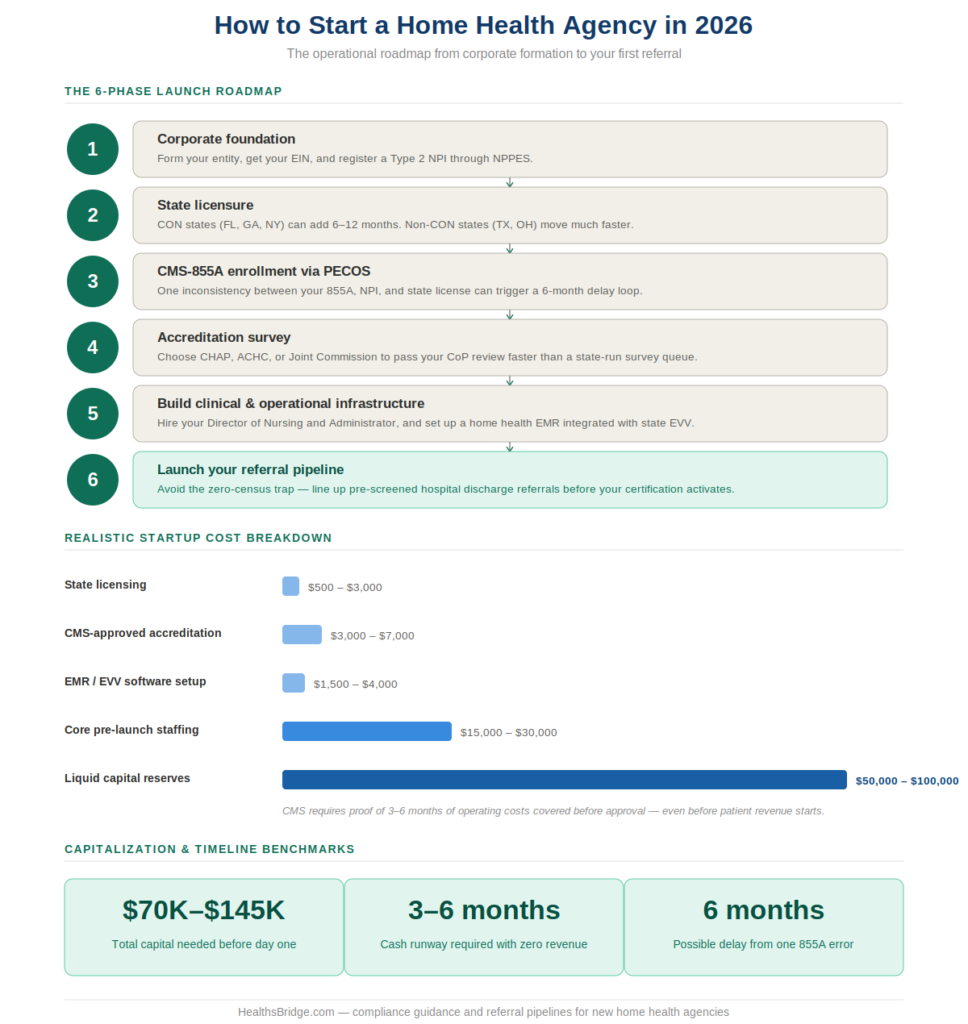
Here’s a realistic breakdown of what you’re looking at:
| Expense Category | Estimated Cost Range | Notes |
|---|---|---|
| State Licensing Fees | $500 – $3,000 | Varies heavily by state; CON states often have additional application fees |
| CMS-Approved Accreditation | $3,000 – $7,000 | Cost depends on which accrediting body (CHAP, ACHC, Joint Commission) and agency size |
| Liquid Capital Reserves | $50,000 – $100,000 | Required to demonstrate 3–6 months of operating costs to CMS during 855A review |
| Software Infrastructure (EMR/EVV) | $1,500 – $4,000 | Initial setup and first few months; ongoing monthly costs apply after |
| Core Pre-Launch Staffing | $15,000 – $30,000 | Director of Nursing, Administrator, and intake/admin staff salaries before revenue starts |
Add it up and you’re looking at somewhere between $70,000 and $145,000 just to get to your first day of operations — and that’s before you’ve factored in office space, insurance, marketing, or anything beyond the bare essentials.
A few notes worth flagging:
The liquid capital reserve isn’t money you spend — it’s money you have to prove you have access to. Some founders use a business line of credit for this rather than tying up cash directly, but you’ll need to check with your specific Medicare Administrative Contractor (MAC) on what documentation they’ll accept.
Accreditation costs vary more than people realize. CHAP tends to run on the lower end, while Joint Commission surveys for larger or multi-location agencies can run higher. We’ll talk more about choosing between these in section 4.
And the staffing line item is one people consistently underestimate. You need a qualified Director of Nursing and Administrator in place before you can even apply for your survey — meaning you’re paying salaries for months before you generate any revenue to offset them.
3. Step-by-Step Regulatory & Licensing Blueprint
Okay, now let’s walk through the actual sequence. This is roughly the order things happen, though some phases overlap depending on your state.
Phase 1: Corporate Foundation
Before anything else, you need the basic legal scaffolding in place.
Start with your business entity — most agencies form as an LLC or corporation, depending on your state and tax situation. Talk to an accountant or attorney about which structure makes sense for you; this isn’t a one-size-fits-all decision.
Once your entity is formed, you’ll need an EIN (Employer Identification Number) from the IRS. This is free and can be done online in about ten minutes, but you can’t skip it — everything downstream depends on it.
Next comes your NPI (National Provider Identifier) — specifically, a Type 2 NPI, which is for organizations rather than individual providers. You’ll get this through the National Plan and Provider Enumeration System (NPPES). This number becomes your agency’s identity in every Medicare and insurance system you’ll interact with going forward.
This phase sounds simple, and mechanically it is. But mistakes here — like a mismatch between your legal business name on your EIN paperwork and what you list on your NPI application — can cause headaches months later when you’re deep into the 855A process and suddenly something doesn’t line up.
Phase 2: Navigating State Licensure
This is where things start to diverge sharply depending on where you’re located, because state licensing requirements for home health agencies vary enormously.
The biggest dividing line is Certificate of Need, usually shortened to CON.
CON states — Florida, Georgia, New York, and roughly two dozen others — require you to prove there’s a documented “need” for a new home health agency in your service area before the state will even consider your license application. This typically involves demonstrating gaps in current service availability, sometimes through a formal application process that can take many months, and in some states, can involve a competitive review where multiple applicants for the same service area are evaluated against each other.
In practice, CON requirements can be one of the biggest bottlenecks in the entire startup process. In the most restrictive CON states, it’s not unusual for the CON approval process alone to take 6-12 months, and in some markets, new licenses may not be issued at all for extended periods.
Non-CON states — Texas, Ohio, and many others — don’t have this barrier. You apply for your state home health license, meet the state’s specific requirements (which usually include things like having your policies and procedures manual ready, your key personnel identified, and sometimes a physical office location established), and once approved, you move forward.
If you’re in a non-CON state, this phase is mostly about paperwork and meeting state-specific requirements. If you’re in a CON state, this phase can dominate your entire timeline — so it’s worth researching your state’s specific CON rules early, before you’ve committed significant capital, so you know what you’re actually signing up for.
Phase 3: The CMS-855A Enrollment Process via PECOS
Once you’ve got your state license (or, in some cases, concurrently with it), you move into Medicare enrollment — and this is where a lot of agencies hit their first major delay.
The CMS-855A form is the Medicare enrollment application for institutional providers, including home health agencies. It’s submitted through PECOS, the Provider Enrollment, Chain, and Ownership System — Medicare’s online enrollment portal.
Here’s the thing about the 855A: it’s long, it’s detailed, and it asks for information about every owner, managing employee, and organizational relationship connected to your agency. Ownership percentages, background information on anyone with a 5% or greater ownership stake, your practice location details, your banking information for direct deposit — all of it has to be accurate and consistent.
And this is where the warning about “a single mistake delaying you by 6 months” comes from. It’s not an exaggeration. If your Medicare Administrative Contractor reviews your 855A and finds an inconsistency — say, an address that doesn’t match your state license, or an owner listed differently than on your corporate documents — they don’t just flag it and move on. They issue what’s called a development request, asking you to clarify or correct the issue. You respond, they review again, and if there’s another issue, the cycle repeats.
Each round of this can take 30-60 days. It’s not unusual for agencies that submitted a sloppy 855A to find themselves six months deep into back-and-forth corrections, all while their staffing costs and capital reserves are quietly draining.
The practical lesson here: treat the 855A like a legal document, not a form. Cross-reference every name, address, and ownership detail against your corporate filings, your state license, and your NPI registration before you submit. If you have any doubt about how to answer a section, get help — the cost of a consultant reviewing your 855A before submission is nothing compared to the cost of a six-month delay.
4. Achieving Compliance: Passing the Accreditation Survey
Once your 855A is moving through the system, attention shifts to proving you can actually run a compliant home health operation. This means passing a survey against the Medicare Conditions of Participation, or CoPs.
Aligning with CMS Conditions of Participation (CoP)
The CoPs are the rulebook for how a Medicare-certified home health agency has to operate. They cover everything from patient rights to clinical record-keeping to quality assessment processes.
You don’t need to memorize the entire CoP document, but you do need to understand the areas surveyors focus on most:
Patient assessments need to be thorough, timely, and properly documented — this includes the OASIS assessment, which feeds directly into your PDGM payment calculations.
Care plans need to be individualized, signed off by a physician, and updated when the patient’s condition changes.
Your QAPI program (Quality Assurance and Performance Improvement) needs to show that your agency is actively monitoring its own performance and making improvements — not just on paper, but with actual data and follow-through.
And your clinical records need to be organized in a way that someone unfamiliar with your agency could review and understand. Surveyors will pull random patient charts and expect to find a clear, complete, and chronological record of care.
If this all sounds like “have your documentation in order,” that’s basically the heart of it. The CoPs aren’t asking you to do anything exotic — they’re asking you to prove, on paper, that the care you’re providing matches what you’re billing for and what you’ve promised your patients.
Choosing an Accrediting Body
Here’s something that surprises a lot of new agency owners: you don’t have to wait for a state survey team to certify you for Medicare. You can choose a private accrediting organization instead, and for most agencies, this is the faster route.
The three major options are CHAP (Community Health Accreditation Partner), ACHC (Accreditation Commission for Health Care), and the Joint Commission.
CHAP has a long history specifically in home health and hospice. Many smaller and mid-sized agencies choose CHAP because the surveyors tend to have deep home health-specific experience, and the process is generally seen as approachable for first-time agencies.
ACHC is also widely used and tends to have a reputation for being consultative — meaning surveyors are often willing to explain what they’re looking for and why, which can be valuable if this is your first survey.
Joint Commission is the most recognized name across all of healthcare, not just home health. Larger agencies, or those planning to scale into multiple states or service lines, sometimes choose Joint Commission for the brand recognition it carries with hospital systems and referral partners — but the survey process tends to be more rigorous and the costs run higher.
The reason private accreditation is generally faster than waiting for a state survey comes down to scheduling and capacity. State survey agencies are often understaffed and have long queues — sometimes many months — for initial certification surveys. Private accrediting bodies operate on a business model where scheduling a survey is part of their service, so once you’re ready, you can typically get on their calendar in a matter of weeks, not months.
If your timeline matters to you — and given how much capital is sitting idle during this process, it should — going the accreditation route instead of waiting for a state survey is usually the better call.
The Mock Survey
Before your real survey, run a mock survey internally. This is one of the highest-value things you can do in the weeks before your actual survey date, because it catches the small, fixable issues that otherwise turn into deficiencies.
Here’s a basic checklist to work through:
Personnel files — for every employee, do you have a current license or certification on file, a completed background check, a signed job description, proof of orientation/training, and current TB testing or health screening documentation where required?
Policy and procedure manual — is it complete, does it match what your staff actually do day to day, and is it signed and dated showing it’s been reviewed?
Patient charts — pull a handful at random. Does each one have a signed plan of care, a completed OASIS assessment, physician orders that are signed and dated, and visit notes that are complete and timely?
Emergency preparedness plan — do you have a written plan, and can your staff describe what they’d do in an emergency if asked?
QAPI documentation — can you show actual evidence of data collection and at least one example of a performance improvement activity, even a small one?
If you walk through this list honestly and fix what’s missing, you dramatically reduce your risk of a failed or delayed survey. Surveyors aren’t trying to trip you up — but they are trained to find gaps, and gaps in personnel files or chart documentation are the most common findings for first-time agencies.
5. Building the Clinical & Operational Infrastructure
While your licensing and accreditation paperwork moves through the pipeline, you need to be building the actual operational backbone of your agency.
Securing Your Executive Team
Two roles are non-negotiable for a Medicare-certified home health agency: the Administrator and the Director of Nursing (sometimes called the Clinical Director).
The Administrator is responsible for the overall management of the agency — operations, compliance, staffing, budgets. CMS requirements for this role typically include relevant healthcare administration experience, though specific educational requirements can vary by state.
The Director of Nursing needs to be a registered nurse, generally with home health or relevant clinical leadership experience. This person oversees clinical operations, supervises clinical staff, and is often the one most directly responsible for the quality of patient care documentation that surveyors will review.
These two roles need to be filled before your survey — you can’t pass a CoP survey without them in place, and surveyors will often interview both during the visit.
A practical note: these are also two of your biggest pre-launch salary expenses, which is part of why that “core pre-launch staffing” line item in the cost table runs $15,000-$30,000. You’re paying for leadership talent for months before that talent has patients to manage.
Selecting Compliant Tech Stacks
Your technology choices aren’t just about convenience — some of them are legally required.
An EMR (Electronic Medical Record) system designed for home health is essential. Not a generic medical records system — one built specifically for home health workflows, because it needs to handle OASIS assessments, PDGM-related documentation, scheduling for field staff, and billing integration with Medicare.
EVV (Electronic Visit Verification) is the other piece, and this one is non-negotiable. Under the 21st Century Cures Act, states are required to implement EVV for Medicaid-funded personal care and home health services. EVV systems verify the time, location, and service type for each visit, usually through a mobile app or telephony check-in system that your field staff use at the start and end of every visit.
Here’s the catch: EVV requirements are state-specific. Each state has either built its own EVV system, contracted with a vendor, or allows agencies to use their own EVV system as long as it integrates with the state’s data aggregator. You need to find out which model your state uses before you pick your EMR, because ideally your EMR and EVV system talk to each other — otherwise your staff end up double-documenting every visit, which is a recipe for errors and frustration.
Budget-wise, this is that $1,500-$4,000 software line item for initial setup, but understand that most EMR/EVV combinations run as ongoing monthly subscriptions after that — typically priced per active patient or per field staff user, so this becomes a recurring operating cost that scales with your census.
6. Scaling From Day One: Bypassing the Referral Desert with HealthsDriven
Here’s the part of the process that most regulatory guides skip entirely — and it’s arguably the part that determines whether your agency survives its first year.
The “Zero-Census” Financial Trap
Picture this: you’ve spent five figures and the better part of a year. Your state license is in hand. Your Medicare certification just came through. Your EMR is set up, your Director of Nursing is hired and waiting, and your accreditation survey went fine.
And now you have zero patients.
This is the moment a lot of new agencies discover their biggest blind spot. They assumed that once they were “open,” referrals would just start flowing in. In reality, hospital discharge planners and case managers — the people who control a huge share of home health referrals — work with agencies they already know and trust. Getting on their radar takes time, relationship-building, and frankly, a track record you don’t have yet.
So what happens? New agencies start sending their newly-hired (and already-paid) staff out to physically visit hospitals, drop off brochures, and try to build relationships from scratch. This takes weeks or months to produce results, if it produces results at all. Meanwhile, your liquid capital reserves — that $50,000-$100,000 you proved you had to satisfy CMS — are draining with every payroll cycle, and almost nothing is coming in to replace it.
This is the zero-census trap, and it’s how agencies that did everything “right” on the compliance side still end up closing within their first 18 months.
Systematic Growth Integration
This is the gap HealthsDriven is built to fill.
Instead of starting your referral relationships from a cold standstill, HealthsDriven works as a B2B infrastructure partner that connects newly-licensed and Medicare-certified agencies with a stream of pre-screened patient referrals — sourced from hospital discharge planners, case managers, and healthcare networks that already have established referral relationships.
The key word here is “pre-screened.” These aren’t cold leads or unverified contacts. Referrals are matched against your agency’s actual capabilities — your service area, your licensed capacity, your accepted payer types — so what comes through is relevant to what you can actually accept and bill for.
For a brand-new agency, this changes the entire opening sequence. Instead of spending your first months after certification trying to manually build hospital relationships from zero, you can have a referral pipeline aligned to your license and service area ready to go close to the moment your certification activates.
Streamlining Revenue Velocity
There’s a financial reason this matters beyond just “having patients,” and it comes back to that capitalization requirement we talked about earlier.
Remember, your liquid capital reserves exist to cover the gap between when you start incurring expenses and when Medicare actually pays you. The faster you can get patients admitted, documented, and billed, the shorter that gap becomes — and the less of your reserve you burn through before you start seeing revenue.
Pre-verified payer-mix referrals help on two fronts here. First, because the patients have already been screened for the basics — payer type, service area, general eligibility — your intake team can move through compliance checks faster, without chasing down information or discovering mid-process that a referral doesn’t actually fit your license. Second, faster intake means faster admission, which means your OASIS assessments, care plans, and first billable visits happen sooner — which means your first Medicare payment cycle starts sooner.
In practical terms, this is the difference between an agency that’s still mostly burning cash six months after opening, and one that’s already turning the corner toward profitability. The regulatory process gets you the right to operate. A working referral pipeline is what turns that right into an actual business.
Conclusion & Action Plan
Starting a home health agency in 2026 is genuinely one of the better business opportunities available right now — the demographic tailwinds are real, and the need for quality home-based care isn’t going away. But the regulatory path is long, detailed, and unforgiving of small mistakes. From corporate formation through CMS-855A enrollment, from choosing your accrediting body through passing your survey, every step has its own way of eating time and money if you’re not careful.
The good news is that none of these steps are mysterious once you know what’s coming. State licensing, Medicare enrollment, accreditation, staffing, and technology — they’re all knowable, plannable, and manageable with the right preparation.
What’s harder to plan for, and what most founders don’t think about until they’re staring at it, is what happens the day after your certification comes through. If you want to avoid spending your first six months as a certified agency sitting with an empty census and a draining bank account, it’s worth lining up your referral pipeline before that day arrives — not after.
If you’re working through this process now, or even just starting to map it out, it’s worth a conversation with HealthsDriven. They can help you understand where compliance gaps tend to slow agencies down, and more importantly, get your agency connected to a referral pipeline that’s ready to activate the moment your license does. Reach out to HealthsDriven at healthsdriven.com to start building your compliance roadmap and your patient pipeline at the same time — not one after the other.