
For most home health agency owners, census volatility is not an abstract problem — it is a monthly financial emergency. One facility contact goes on leave and referral volume drops 30%. A competing agency accepts a faster turnaround time and your primary discharge planner stops calling. These are not edge cases. They are the default operating reality for agencies that have built their growth strategy on personal relationships rather than a structured referral pipeline.
This guide is not about tips for attending hospital appreciation events or dropping off cookies at a case management department. It is a systematic, step-by-step operational blueprint for agency owners and business development managers who want to build a repeatable, measurable hospital discharge referral pipeline that does not depend on any single relationship, staff member, or informal arrangement.
Key statistic

Agencies with a formalized referral intake and BD process report 2.3x higher census stability year-over-year compared to agencies relying on informal referral relationships. (Source: Home Health Care News, 2024 Agency Operations Survey)
The census problem: why most agencies rely on unpredictable referral sources
Average agency census volatility and what it costs in monthly revenue
Census volatility is the gap between your agency’s licensed capacity and your actual average daily census — and for most independent home health agencies, that gap is significant. Industry data consistently shows that the average home health agency operates at 68–75% of its potential census capacity, primarily due to inconsistent referral volume rather than a shortage of patient demand.
The financial cost is direct and compounding. Under the Patient-Driven Groupings Model (PDGM), a single 30-day episode for a Medicare beneficiary generates an average base payment of approximately $1,900–$2,200 before case-mix and comorbidity adjustments. An agency managing 80 active patients versus 65 active patients is not slightly more profitable — it is operating with a meaningfully different monthly revenue floor. At scale, a 10-patient census swing can represent $20,000–$30,000 in monthly revenue variance.
For agencies running lean on clinical staffing, this volatility also triggers a destructive cycle: low census leads to reduced staff hours, which damages morale and accelerates turnover, which limits the agency’s ability to accept referrals when volume returns — which then drives discharge planners toward more reliable competitors.
Why over-reliance on one or two referral relationships is a structural risk
Most agencies that experience sudden census drops can trace the problem back to a single root cause: their referral pipeline was not a pipeline at all. It was a dependency on two or three individual relationships with discharge staff at a handful of facilities.
When a single hospital case manager accounts for 40% or more of an agency’s referral volume, that relationship is not an asset — it is a concentration risk. Staff turnover in hospital case management departments runs at 20–25% annually. A retirement, a promotion, or a departmental restructuring can eliminate years of relationship-building overnight with no warning and no mitigation path.
A sustainable pipeline is defined by referral source diversity: no single facility, case manager, or health system should represent more than 20% of your total referral volume. Achieving that threshold requires deliberate, systematic outreach — not just deeper investment in existing relationships.
The shift in hospital discharge workflows post-COVID-19 and what it means for agency BD teams
The post-COVID hospital environment has materially changed how discharge decisions are made and how home health agencies need to position themselves within that process. Several structural shifts have created both new risks and new opportunities for agency BD teams.
- Accelerated discharge timelines: Average hospital length of stay has compressed further since 2020, increasing pressure on discharge planning staff to move quickly. Agencies with slow or bureaucratic intake processes are being deprioritized in favor of faster-responding competitors.
- Centralized referral management: Major health systems have increasingly moved to centralized discharge planning operations, where a single care transitions team manages referrals across multiple facilities. This means losing one relationship can affect referral access to an entire hospital system, not just a single building.
- Payor mix scrutiny: Discharge planners are under institutional pressure to route patients to agencies that accept their payor type without exception or negotiation. Agencies that apply selective admission criteria are being quietly removed from preferred vendor lists without explicit communication.
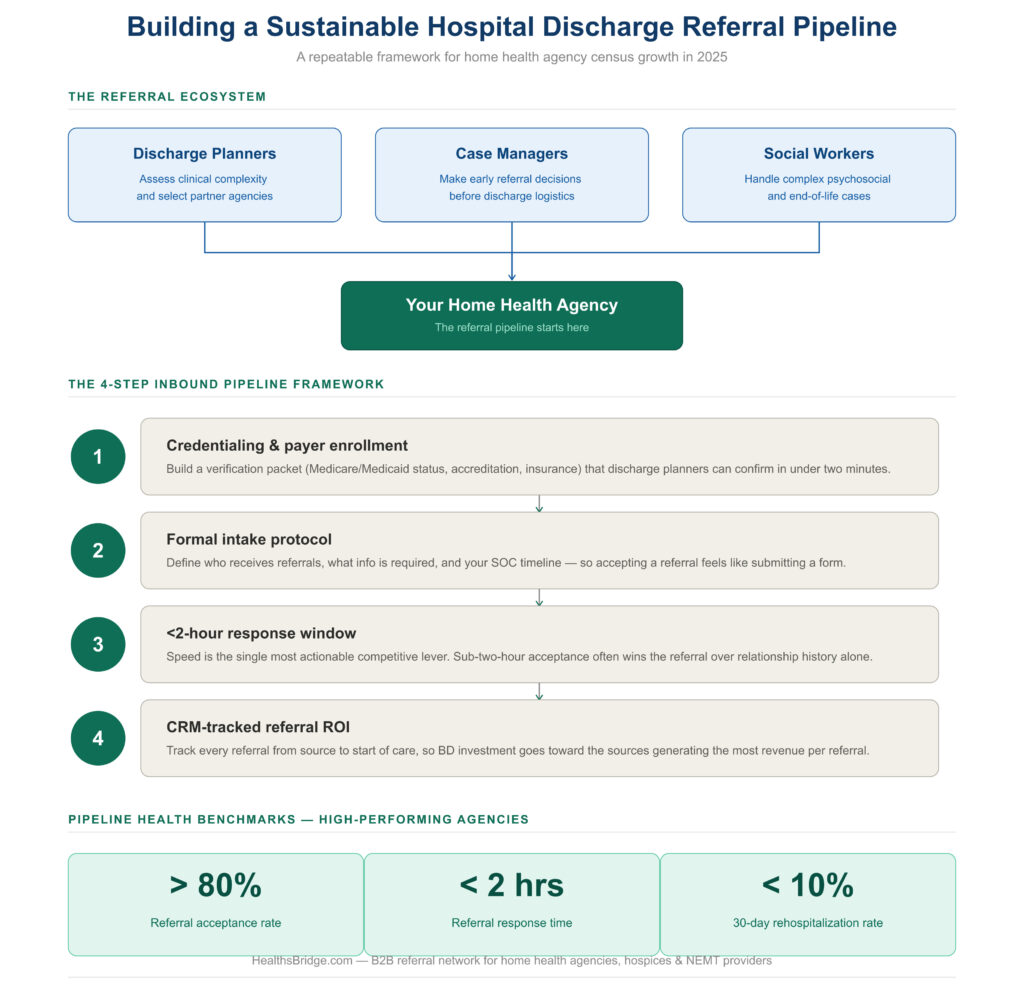
Understanding the hospital discharge referral ecosystem
Key decision-makers: discharge planners, case managers, and social workers
A persistent mistake in home health BD strategy is treating “the hospital” as a monolithic entity. In practice, referral decisions are distributed across three distinct role categories, each with different clinical responsibilities, institutional pressures, and criteria for selecting a home health partner.
Hospital discharge planners are typically RNs whose primary clinical function is determining the appropriate post-acute care setting for each patient. They assess clinical complexity, insurance type, home environment, and caregiver support in making disposition decisions. For home health referrals specifically, they are evaluating your agency’s clinical capacity, payor acceptance, and geographic service area.
Case managers in larger health systems often sit upstream of discharge planners, managing care coordination throughout the inpatient stay. They frequently make the initial referral decision before discharge planning finalizes logistics. Building relationships with case managers — not just discharge planners — gives agencies earlier access to the referral decision before competing agencies are contacted.
Medical social workers manage psychosocial barriers to discharge, including patient and family resistance to post-acute care, insurance access issues, and community resource coordination. Their influence on home health referrals is highest for patients with complex social determinants or end-of-life planning needs. Social workers are frequently the most responsive to agencies that invest in educational relationship-building rather than pure sales outreach.
How referral decisions are actually made: compliance, payor mix, and speed-to-accept
The single most important insight for any agency BD strategy is this: discharge planners do not select home health agencies based on relationship quality alone. They select agencies based on operational reliability — and relationship quality is the tiebreaker when multiple reliable agencies are available.
In practice, a discharge planner’s selection criteria typically operate as a sequential compliance checklist before any relational factors are weighted:
- Does the agency hold current Medicare and Medicaid certification for this patient’s payor type?
- Does the agency serve the patient’s home zip code?
- Does the agency have clinical capacity to admit today?
- Has the agency responded to the referral within an acceptable timeframe?
- Does the agency have a track record of clinical reliability (low rehospitalization, good HHCAHPS, responsive communication)?
Only after all compliance gates are cleared does the discharge planner’s personal preference for an agency BD contact influence the decision. Agencies that invest in BD relationships before optimizing their compliance and intake infrastructure are building on an unstable foundation.
The role of LTACH and SNF transitions in home health referral volume
Hospital discharge is not the only referral pathway worth building. Long-term acute care hospitals (LTACHs) and skilled nursing facilities (SNFs) represent a materially different but high-volume referral channel that most home health BD teams underinvest in.
SNF-to-home transitions represent a distinct patient profile: higher clinical complexity, longer and more expensive episodes under PDGM, and a discharge coordinator audience with more time for relationship development than a hospital discharge planner working under acute-care LOS pressure. LTACH discharges similarly produce higher-acuity patients with greater episode payment rates under PDGM comorbidity adjustments.
A comprehensive referral pipeline strategy targets hospital discharge, SNF discharge coordinators, and LTACH case management departments as separate BD channels with tailored messaging and different intake protocol priorities for each.
Building a systematic inbound referral pipeline: a step-by-step framework
The following four-step framework is designed for agencies at any census level. It is sequenced deliberately: each step must be in place before the next one can perform effectively. Skipping Step 1 to begin outreach in Step 4 is one of the most common BD mistakes agency owners make.
Step 1: Credentialing and payer enrollment as prerequisite trust signals
Before any BD activity is worthwhile, your agency must present a complete and current credentialing profile to every potential referral source in your market. Credentialing here means not just Medicare certification, but a comprehensive package that a discharge planner can verify in under two minutes:
- Current Medicare and Medicaid provider status with active NPI and PECOS enrollment
- Commercial payer contracting: minimum coverage for the top 3 commercial payers in your service market
- Accreditation status (CHAP, ACHC, or Joint Commission) or active CMS Conditions of Participation compliance documentation
- Liability insurance certificates and surety bond documentation
- State licensure certificate and any required specialty endorsements
This packet should be immediately accessible on your website, in a PDF leave-behind, and in your intake coordinator’s email signature. Agencies that require a discharge planner to make a phone call to verify your credentialing status are losing referrals to competitors who make verification effortless.
Step 2: Establishing a formal intake protocol hospitals can rely on
A “formal intake protocol” does not mean a complex intake process. It means a predictable one. Hospital discharge staff route referrals to agencies they trust to respond consistently — not just quickly on good days, but at 4:45pm on a Friday before a holiday weekend.
Your intake protocol must define:
- Who receives referrals (named coordinator with backup coverage during all business hours)
- What information is required vs. optional for an initial acceptance decision
- What your agency’s capacity threshold is — and what happens when you are near capacity
- How and when the referral source receives a status update after submission
- What your standard SOC timeline is by referral type (hospital discharge, SNF discharge, community referral)
The goal is to make your intake process feel more like submitting a form than making a request. Discharge planners manage dozens of referrals simultaneously. The agency that removes friction from the referral process will receive referrals preferentially, regardless of relationship history.
Step 3: Response time benchmarks — why a <2-hour acceptance window is a competitive differentiator
Response time is the most actionable, most immediate competitive lever available to any home health agency. CMS does not publish a required response time standard, but the de facto market standard in competitive markets has converged around a two-hour acceptance window for hospital discharge referrals.
In markets where discharge planners are managing multiple competing agencies, a response time under two hours frequently results in referral preference independent of price, specialization, or relationship history. An agency that calls back in 45 minutes will receive the referral over an agency that calls back in 3 hours, even if the slower agency has a superior clinical reputation.
Operationally, achieving consistent sub-two-hour response times requires:
- Dedicated intake phone line with real-time staffing during all posted business hours
- After-hours answering coverage with next-business-day guarantee for non-urgent referrals (and same-hour coverage for urgent discharges)
- Intake coordinator empowered to give a preliminary acceptance decision without supervisory approval for standard referral types
- Documented escalation protocol for complex or high-acuity referrals that require clinical review before acceptance
Step 4: Tracking referral source ROI with a basic CRM workflow
A referral pipeline without measurement is not a pipeline — it is a wish. The fourth component of a systematic intake operation is a CRM workflow that tracks every referral from source to start of care, enabling BD decisions to be made on data rather than intuition.
Even a spreadsheet-based CRM is sufficient for agencies under 100 active patients if it captures:
- Referral source (facility name, specific case manager or discharge planner, and department)
- Referral date and time, and time of first agency response
- Referral outcome: accepted, pended, or declined — with reason documented for each non-acceptance
- Start of care date (if accepted and converted)
- Episode revenue (actual reimbursement at close of episode)
With this data, an agency can calculate the exact revenue value of each referral source relationship and make an evidence-based decision about where to concentrate BD investment. A referral source generating 10 referrals per month with a 50% conversion rate and high clinical complexity is worth significantly more quarterly BD investment than a source generating 20 referrals with a 25% conversion rate and frequent LUPA risk profiles.
Outbound BD tactics that actually work in 2025
How to approach hospital case management departments without getting blacklisted
Unsolicited, high-frequency outreach to hospital case management departments is one of the fastest ways to permanently damage an agency’s referral access at a facility. Discharge planners and case managers receive a high volume of vendor outreach and have developed institutional reflexes against sales-oriented contact.
The approach that works in 2025 is value-first, consultation-framed outreach:
- Initial contact via a formal letter or email to the Director of Case Management (not a cold call to the department floor), introducing your agency and requesting a 20-minute clinical capabilities review
- The framing should be explicitly non-sales: you are introducing your agency as a clinical resource and verifying your intake profile is current in their vendor database
- Bring a leave-behind packet: credentialing summary, service area map, specialty capabilities, HHCAHPS outcomes data, and a one-page intake process guide
- Request only one action: to be added to the facility’s approved vendor list if you are not already on it
This approach positions your agency as a professional partner rather than a vendor seeking business — a distinction that discharge planning directors are highly attuned to and that significantly improves the probability of preferential routing.
Building referral agreements and service-level expectations
Formalizing your referral relationships with written service-level agreements (SLAs) is an underused BD tool that simultaneously signals professionalism and creates mutual accountability. A referral SLA does not need to be a legal contract — it is a one-page summary of what each party commits to in the referral and admission process.
From the agency side, a referral SLA typically commits to:
- Response time standard for all referrals (e.g., within 2 business hours for standard referrals, within 1 hour for urgent discharges)
- Minimum payer types accepted without prior authorization requirements
- Geographic service area with any exceptions clearly defined
- Communication protocol for post-admission status updates
- 30-day readmission notification commitment
From the facility side, the SLA requests only:
- Preferred referral submission method (fax, portal, phone, or electronic referral system)
- Key contact information for primary and backup case management staff
Agencies that present SLAs to hospital case management directors consistently report higher referral volume from those facilities within 90 days — not because the SLA is legally binding, but because it signals the kind of operational discipline that discharge planners want in a preferred partner.
Quarterly QBR meetings with top referral sources: what to bring and what to measure
Quarterly Business Reviews (QBRs) are a practice borrowed from enterprise B2B sales that translates directly and powerfully to home health BD. A QBR is a structured, data-driven quarterly meeting with your top 3–5 referral sources that reviews outcomes data and strengthens the institutional relationship beyond individual staff contacts.
What to bring to a QBR:
- Referral volume summary: total referrals received, accepted, pended, and declined by quarter
- Clinical outcomes report: 30-day rehospitalization rate, HHCAHPS functional improvement scores, and patient/caregiver satisfaction data for patients referred by this facility
- Episode management update: average days to SOC, average episode length, and care plan adherence rate
- Operational improvement initiatives your agency has implemented in response to prior feedback
What the QBR accomplishes strategically: it replaces the transactional, visit-based BD relationship model with an institutional, data-driven partnership model. When your agency is presenting clinical outcome reports to a hospital case management director, you have moved from vendor to strategic partner — a position that survives individual staff turnover because the relationship is with the institution, not the individual.
Key metrics to measure referral pipeline health
A referral pipeline that is not tracked is not managed. The following five metrics provide a complete operational view of your referral pipeline’s performance and are sufficient for agencies of any size to diagnose bottlenecks and track improvement over time.
Referral acceptance rate vs. referral conversion rate
These two metrics are frequently confused but measure fundamentally different things.
Referral acceptance rate is the percentage of incoming referrals your agency accepts (formally agrees to evaluate for admission). A healthy acceptance rate for a general home health agency is 70–85%. Acceptance rates below 60% typically indicate a payor mix restriction issue, a geographic coverage gap, or a clinical capacity problem.
Referral conversion rate is the percentage of accepted referrals that result in an actual start of care. A healthy conversion rate is 60–75%. Conversion rates below 50% indicate a breakdown in the post-acceptance process — typically slow SOC scheduling, family hesitancy that intake coordinators are not addressing, or clinical eligibility screening failures.
The combined pipeline efficiency (acceptance rate × conversion rate) is your agency’s true referral yield. An agency with a 75% acceptance rate and a 65% conversion rate converts approximately 49% of all incoming referrals into active patients. Identifying which rate is suppressing yield is the first diagnostic step in pipeline optimization.
Cost-per-start (CPS) benchmarks by agency size
Cost-per-start is the total cost of your BD and intake operations divided by the number of new patient starts in a given period. It is the single most important financial efficiency metric for your referral acquisition function.
CPS calculation: (Total BD staff cost + Marketing spend + CRM/technology cost) ÷ Total new starts in period
Industry benchmarks by agency size:
- Small agencies (< 50 avg. census): $400–$700 CPS
- Mid-size agencies (50–150 avg. census): $250–$500 CPS
- Large agencies (150+ avg. census): $150–$350 CPS
Agencies with CPS significantly above the benchmark for their size are typically over-investing in BD activities without the intake infrastructure to convert referrals efficiently. Reducing CPS requires parallel investment in both referral volume growth and intake conversion improvement.
30-day rehospitalization rate as a referral retention lever
Your 30-day rehospitalization rate is not only a quality measure — it is a BD metric. Hospital discharge planners and case managers track rehospitalization rates for the agencies they refer to, and high readmission rates directly damage referral relationships with facilities operating under value-based care contracts and bundled payment arrangements.
From a BD perspective, your agency’s rehospitalization rate needs to be:
- Tracked per referral source, not just in aggregate, so you can identify whether high-readmission patients are concentrated among specific referral partners or specific clinical groupings
- Presented proactively to referral sources in QBRs as evidence of clinical quality
- Benchmarked against the CMS national average (approximately 14–16%) and used as a competitive differentiator in BD conversations when your rate is below the benchmark
A 30-day rehospitalization rate below 10% is a credible, data-supported competitive advantage in any home health BD conversation. Agencies that achieve and publicize below-benchmark readmission rates consistently report higher referral volume from hospital case management departments, independent of BD outreach frequency.
Referral pipeline performance benchmarks: quick-reference table
Use the table below to assess where your agency currently stands and identify the highest-priority metrics to address in your next 90-day operational plan.
| Metric | Underperforming | Average | High-performing |
|---|---|---|---|
| Referral acceptance rate | < 55% | 55–75% | > 80% |
| Referral conversion rate | < 40% | 40–60% | > 65% |
| Response time (hours) | > 4 hrs | 2–4 hrs | < 2 hrs |
| Cost-per-start (CPS) | > $850 | $500–$850 | < $350 |
| 30-day rehospitalization rate | > 18% | 12–18% | < 10% |
Conclusion: the pipeline you build today protects the census you need tomorrow
Building a sustainable hospital discharge referral pipeline is not a marketing project. It is an operational infrastructure project — one that requires investment in credentialing, intake protocol, response capacity, BD relationship architecture, and data measurement in sequence.
The agencies that dominate their local home health markets in 2025 are not the ones with the most charismatic BD staff. They are the ones that have made themselves the most operationally reliable partner in their referral ecosystem — the agency that a discharge planner calls first because they know the response will come within two hours, the intake will run smoothly, and the clinical outcomes will protect the facility’s value-based care performance.
Begin with your credentialing packet. Build your intake protocol next. Measure your response time this week. And if the referral volume your agency needs to stabilize census exceeds what your internal BD capacity can generate, explore what a structured referral partnership — like the HealthsDriven network — can provide as a complement to your existing BD operation.